That progress can be encouraging. But you may also be asking an important question:
How do I lose body fat without losing the muscle, strength and energy I need?
I am glad women are asking this. The goal should never be to become smaller at any cost. The goal is to improve your body composition while protecting your ability to train, move well, maintain independence and feel strong in your body.
A GLP-1 medication can be one part of a medically supervised weight loss plan. It does not replace strength training, adequate nourishment, recovery or human guidance. Those pieces still matter, especially for women in their 40s, 50s and 60s.
The Quick Answer
To protect muscle while taking a GLP-1, use progressive resistance training at least two days each week, consume an individualized amount of protein and total nutrition, avoid turning appetite suppression into an extreme calorie deficit, stay hydrated, recover between workouts and monitor strength and function in addition to scale weight. Your prescribing clinician should manage the medication, dose and side effects. A qualified fitness and nutrition coach can help you consistently execute the lifestyle side of the plan.
Important: This article provides general fitness and nutrition education. It is not medical advice and does not replace care from your physician, prescribing clinician or registered dietitian. Do not begin, stop or change the dose of a GLP-1 medication without your prescriber.
Do GLP-1 Medications Cause Muscle Loss?
Weight loss from any method can include a combination of fat mass and lean mass. That includes weight loss produced through calorie restriction, bariatric surgery and medications.
It is also important to understand that lean mass is not the same thing as pure skeletal muscle. Measurements such as a DXA scan classify water, glycogen, organs and other nonfat tissue within lean mass. A decrease in lean mass therefore cannot automatically be described as the same amount of muscle tissue lost.
In a DXA substudy from the STEP 1 trial, participants receiving semaglutide 2.4 mg lost an average of 15 percent of body weight over 68 weeks. Total fat mass fell 19.3 percent, visceral fat mass fell 27.4 percent and total lean mass fell 9.7 percent. Although absolute lean mass decreased, lean mass represented a larger percentage of the participants’ remaining body weight. The substudy included 140 participants and 76 percent were women. Read the STEP 1 body composition analysis.
The 2025 SURMOUNT-1 DXA substudy provides additional context. Among 160 participants, tirzepatide produced an average body weight reduction of 21.3 percent. Approximately 74 percent of the weight lost came from fat mass and 26 percent came from lean mass. The placebo group lost weight in a very similar proportion, with 75 percent from fat and 25 percent from lean mass. The pattern was generally consistent across age and sex subgroups. Read the SURMOUNT-1 body composition study.
This does not mean muscle health should be ignored. It means the science deserves a more accurate message than “GLP-1 medications eat your muscle.” Most of the measured weight loss in these trials was fat. At the same time, a meaningful amount of lean tissue may be lost during substantial weight reduction, so protecting strength and muscle should be planned from the beginning.
What the Science Can and Cannot Tell Us Yet
Researchers are actively studying the best way to preserve muscle during GLP-1 supported weight loss. A 2026 randomized trial called LEAN-PREP is testing resistance exercise, increased protein, and their combination in people beginning semaglutide or tirzepatide. That trial is designed to measure quadriceps size with MRI, along with strength and physical function, but its outcome data are not yet available. View the LEAN-PREP study protocol.
That means the most responsible recommendations currently combine what we know about GLP-1 body composition changes with stronger evidence from weight loss and resistance training studies in women and older adults. No honest coach should pretend that every GLP-1 muscle question has already been answered.
Why Protecting Muscle Matters So Much After 40
Muscle is not only about appearance. It supports strength, balance, bone loading, glucose use, physical confidence and your ability to handle everyday life.
For a woman over 40, preserving muscle can help you continue doing things that matter to you, such as carrying groceries, hiking, traveling, playing with children or grandchildren and feeling capable in your own body.
The number on the scale cannot tell you whether you are becoming stronger. It also cannot tell you how much of your change is fat, muscle, water or stored carbohydrate. That is why your plan should measure more than pounds.
7 Ways to Protect Muscle While Taking a GLP-1
1. Make Progressive Strength Training the Foundation
Walking is valuable for health, mood and daily movement, but walking alone does not provide the same muscle building signal as resistance training.
The Physical Activity Guidelines for Americans recommend muscle strengthening activities involving the major muscle groups on at least two days each week. Your personal plan may include two, three or more strength sessions depending on your experience, schedule, recovery, symptoms and goals. See the federal physical activity recommendations.
Your program should train the major movement patterns with exercises appropriate for your body and ability. These may include:
- Squats or sit-to-stands
- Hip hinges or Romanian deadlifts
- Rows and pulldowns
- Chest presses or elevated pushups
- Step-ups and split squats
- Shoulder presses
- Loaded carries and intentional core work
The key is progression. Over time, you gradually increase resistance, repetitions, sets, control or movement quality. Random workouts that never become more challenging are less effective for protecting muscle.
In a randomized trial of older women completing a weight loss program, the groups that exercised improved muscle strength while the diet only group lost strength. This is an important reminder that protein by itself cannot replace a training stimulus. Read the trial in older women.
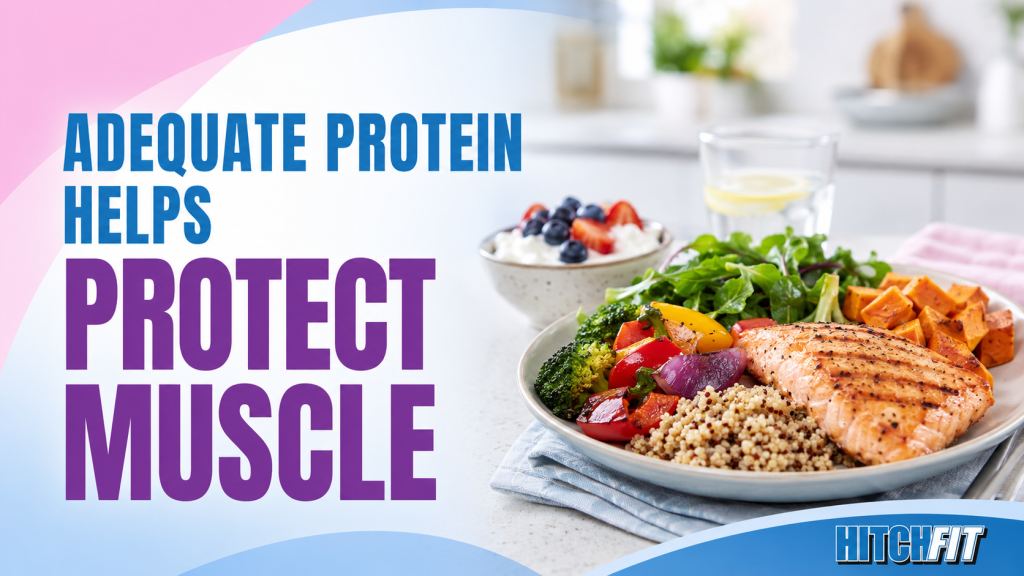
2. Make Protein a Daily Priority
When appetite decreases, protein can become harder to consume. That makes planning more important, not less important.
Your ideal protein intake depends on your body size, health history, kidney function, total calorie intake and activity. There is no single internet number that is correct for every woman. Work with your healthcare professional and qualified nutrition provider to establish an appropriate target.
Research does support the value of adequate protein during weight loss. In a randomized study of women ages 28 to 80, the higher protein group lost less lean mass than the normal protein group during a 12 week calorie deficit. Read the higher protein weight loss study in women.
Another randomized trial in older adults combined calorie restriction with resistance training. Participants consuming about 1.11 grams of protein per kilogram per day through a whey, leucine and vitamin D enriched supplement preserved appendicular muscle mass better than the control group, which averaged about 0.85 grams per kilogram per day. This study does not establish one universal target, but it shows why protein deserves attention during intentional weight loss. Read the randomized muscle preservation trial.
Practical protein options may include eggs, Greek yogurt, cottage cheese, chicken, turkey, fish, lean beef, tofu, tempeh, lentils or a protein shake when solid food is difficult to tolerate. The best choice is one that fits your medical needs and that you can consume consistently.
3. Do Not Turn Reduced Appetite Into a Crash Diet
A lower appetite can make it easier to create the calorie deficit needed for fat loss. But “I am not hungry” does not automatically mean your body has received enough protein, vitamins, minerals, fiber, carbohydrate, essential fat or fluid.
More restriction is not always better. A plan that becomes too aggressive may leave you too depleted to train well, recover or maintain normal daily activity. Rapid scale loss is not the only measure of success.
If you repeatedly cannot eat enough to meet the nutrition plan established with your care team, contact your prescribing clinician. Do not change the medication or dose on your own.
4. Use Smaller, Nutrient Dense Meals When Needed
Large meals may feel uncomfortable for some people taking these medications. Smaller meals can make it easier to consume protein and other nutrients without forcing an oversized plate.
A simple structure is to begin with a tolerable protein source, include produce, and add an appropriate portion of carbohydrate and healthy fat based on your plan. For example:
- Greek yogurt with berries and a small amount of nuts
- Eggs with whole grain toast and fruit
- Chicken or tofu with rice and vegetables
- Salmon with potato and greens
- A protein shake with fruit when solid food is difficult
You do not need to eliminate carbohydrates to protect muscle. Carbohydrates can support training performance, while dietary fat supports health and makes meals satisfying. Your plan should include all three macronutrients in amounts appropriate for you.
5. Hydrate and Take Persistent Digestive Symptoms Seriously
Current FDA prescribing information for semaglutide and tirzepatide lists digestive side effects such as nausea, vomiting, diarrhea and constipation. These medications can also delay gastric emptying. Ongoing vomiting or diarrhea may contribute to dehydration and can make adequate nutrition difficult. View current FDA information for Wegovy and current FDA information for Zepbound.
Contact your healthcare provider if symptoms are severe, persistent or prevent you from keeping down food and fluids. Seek prompt medical guidance for severe abdominal pain, symptoms of dehydration, new vision changes or other concerning symptoms listed in your medication guide. Tell your healthcare team that you use a GLP-1 medication before surgery or a procedure involving anesthesia or deep sedation.
6. Track Strength, Function and Body Composition Trends
Do not allow the scale to become the only voice in the room. Track indicators such as:
- The weights and repetitions you complete
- Your ability to stand from a chair, climb stairs and carry objects
- Your energy and recovery
- Waist and body measurements
- How your clothing fits
- Progress photographs
- Body composition testing when appropriate and available
If your scale weight is falling but your strength is dropping quickly, fatigue is increasing and you cannot complete normal workouts, the plan deserves review. That is useful information, not personal failure.
7. Build a Plan That Can Adjust With You or Hire a Coach to help you with this
Your appetite, energy, digestive tolerance and training ability may change as your medication is started or adjusted. A rigid plan downloaded once cannot see those changes.
This is where direct human coaching matters. Your coach should review what is actually happening, help you problem solve and adjust the training and nutrition plan within the coach’s professional scope. Your medical provider remains responsible for the medication itself.
A Simple Muscle Protective Weekly Structure
Your exact schedule should be customized, but a beginner may start with a structure like this:
- Monday: Full body strength training
- Tuesday: Walking and mobility
- Wednesday: Full body strength training
- Thursday: Recovery or easy movement
- Friday: Full body strength training
- Saturday: Walking or an enjoyable activity
- Sunday: Recovery and preparation
More is not automatically better. The right amount is the amount that challenges your muscles and still allows you to recover, nourish your body and return stronger.
Common Mistakes to Avoid on a GLP-1
- Eating as little as possible: Appetite suppression is not a contest.
- Doing only cardio: Cardio supports health, but resistance training provides the direct muscle stimulus.
- Ignoring protein until dinner: Plan protein sources throughout the day in a pattern you can tolerate.
- Training hard while consistently underfueled: Your workouts and nutrition must support one another.
- Judging success only by pounds: Strength, measurements, function and energy also matter.
- Changing the medication yourself: Dose and side effect decisions belong with your prescriber.
- Following a generic plan that never adjusts: Your response and circumstances are personal.
The Story You Tell Yourself Matters Too
Sometimes the sticking point is not a lack of information. It is a familiar loop in the story:
“If the scale slows down, I am failing.”
“If eating less works, eating almost nothing must work better.”
“I have started over before, so I will probably fail again.”
Those thoughts can push a woman toward extremes or convince her to quit when the plan simply needs to be adjusted.
As a Certified Trauma and Resilience Life Coach, I help women notice where old survival patterns, all-or-nothing thinking, or shame may be shaping current choices. This is not psychotherapy and it does not replace medical or mental health care. It is coaching that helps you become aware of the loop, respond differently, and continue moving toward the life you want.
Can You Build Muscle While Taking a GLP-1?
It may be possible, especially for a woman who is new to strength training, returning after time away or able to train progressively while eating adequate protein and total nutrition. However, when weight loss and the calorie deficit are substantial, preserving existing muscle may be the more realistic primary goal.
That is still a major win. Losing body fat while maintaining strength, function and as much muscle as possible is a very different outcome from simply chasing the lowest scale number.
Strong & Fit Over 40 Customized Coaching
If you are using a GLP-1 medication and need a strength training and nutrition plan built around you, the Strong & Fit Over 40 customized online plan can meet you where you are.
You work directly with me, Diana. Your weekly check ins are reviewed by me, not an AI system and not an automated program. I look at your progress, your energy, your training, your nutrition and the sticking points you are encountering. Then I guide you through the next step.
I can coach women who use a GLP-1 and women who do not. I can also work with women who use HRT and women who do not. Your prescribing clinician manages your medication. I provide the customized training, nutrition structure, accountability, mindset support and human coaching that help you protect what matters while pursuing fat loss.
Frequently Asked Questions
Does taking a GLP-1 automatically cause muscle loss?
No. Significant weight loss often includes some lean mass loss, whether it comes from medication, calorie restriction or another method. Lean mass is also not identical to skeletal muscle. GLP-1 body composition studies show that most weight lost was fat, but strength training, adequate protein and sufficient overall nutrition remain important for protecting muscle.
How much protein should I eat while taking a GLP-1?
There is no single target that is right for every person. Protein needs depend on body size, age, activity, total calorie intake, kidney function and medical history. A general goal to aim for is about 1 gram of protein per pound of ideal body weight.
How often should I strength train while taking a GLP-1?
Federal physical activity guidance recommends training all major muscle groups on at least two days each week. Some women may use three or more sessions, but the schedule should match experience, recovery, medical guidance and current symptoms. Hitch Fit encourages a minimum of 3 days of strength training, which can be built up to for a beginner, and if someone is intermediate or advanced they may train more frequently based on fitness and preferences.
Is walking enough to prevent muscle loss on a GLP-1?
Walking is excellent for health and daily movement, but it does not replace progressive resistance training. Protecting muscle requires a repeated strength stimulus that challenges the major muscle groups.
Can I build muscle while losing weight on a GLP-1?
Some people can build muscle, especially beginners and those returning to strength training. During a large calorie deficit, preserving muscle and strength may be the more realistic initial goal. Progressive training, adequate nutrition and recovery improve the opportunity for a favorable result.
Can the Strong & Fit Over 40 plan work if I take a GLP-1 or use HRT?
Yes. Diana can customize the fitness and nutrition coaching for women who use a GLP-1 or HRT and for women who use neither. Your licensed prescribing clinician remains responsible for medication decisions, while Diana provides direct human coaching for training, nutrition, accountability and mindset.
Scientific References
- Wilding JPH. Impact of Semaglutide on Body Composition in Adults With Overweight or Obesity: Exploratory Analysis of the STEP 1 Study. 2021.
- Look M, Dunn JP, Kushner RF, et al. Body composition changes during weight reduction with tirzepatide in the SURMOUNT-1 study. 2025.
- Exercise and Protein Effects on Strength and Function with Weight Loss in Older Women. 2020.
- Leidy HJ, Carnell NS, Mattes RD, Campbell WW. Higher protein intake preserves lean mass and satiety with weight loss in women. 2007.
- Verreijen AM, et al. A high whey protein, leucine and vitamin D enriched supplement preserves muscle mass during intentional weight loss in older adults. 2015.
- LEAN-PREP randomized controlled trial protocol. 2026.
- Physical Activity Guidelines for Americans.
- FDA prescribing information for Wegovy. 2026.
- FDA prescribing information for Zepbound. 2026.
Medical disclaimer: This information is educational and is not intended to diagnose, treat, cure or prevent disease. Consult your licensed healthcare provider for medical advice and medication management.

