What Planning For a Dinner Party Can Tell You About Designing Training Programs – Tony Gentilcore

One of my least favorite things to do as a bonafide member of the “I’m an introvert and would rather jump into a live volcano than entertain people” club…is to plan for a dinner party. Granted, it’s pretty much a requisite as a man who’s married to a woman who loves to host dinner parties that it’s going to happen every so often in our household.
Don’t get me wrong: I can turn “it” on when I have to. It may drain my social battery for the next week, but I can.
Which brings me to today’s musings. We hosted friends for dinner recently and all the preparation for that got me thinking about writing training programs. Because you know, I’m normal.
What Planning for a Dinner Party Can Tell You About Writing Training Programs
No surprise, there’s a lot to consider and plan for when constructing a classy dinner party:
- Picking the perfect Canva template for the invitations.
- Should you get catering or will this be a self-culinary event?
- What kind of playlist for background music?
- Should there be any board games involved?
- Finally, and I’m just spitballing here, but what about maybe requiring a password to enter? We could go all Eyes Wide Shut and make things weird:
Annnd, Get Me the Fuck Outta Here
All of the above are important things to ponder.
(Don’t you dare forget about the cheese board).
Above all else, of course, would be ensuring your place is spic and span for your guests.
Think about it this way: If you’re planning on having guests over for dinner, and you need to tiddy up the place, where are you going to concentrate your efforts?
- Vacuuming the floors?
- Dusting?
- Cleaning (and putting away) all the dirty dishes in the sink?
- Making sure there isn’t any dirty laundry laying around?
- Fluffing the pillows on the couch?
- Lighting a few scented candles for some added ambiance, perhaps?
Those all sound like winners to me.
You’re likely not going to focus on iron pressing your ties, scrubbing down the shower, or, I don’t know, organizing your spice rack alphabetically.
The point is: You’re going to focus on the “big rocks” and save the superfluous, extraneous minutiae for another time.
By comparison, when working with a personal training client and you only have, if you’re lucky, two, maybe three hours per week with them, what should be the priority with regards to their training program?
More globally, what THEMES should be emphasized to help him or her make long-term progress that sticks?
NOTE: The answer to both questions can (and should) be dictated by one’s goal(s), injury history, and ability level (to name a few)…
…but let’s briefly take fat-loss as an example.
Speaking for myself, if a client of mine expresses interest in focusing on fat-loss, from a programming standpoint I’m going to concentrate my efforts toward the BIG ROCKS:
1️⃣ Discuss Strategies to Promote a Caloric Deficit
There’s myriad of things to consider and take into account:
- Lifestyle
- Social Support
- Medical History
- Favorite Color
- Socioeconomic Considerations
- Food Likes and Dislikes
- One’s “Relationship” With Food
- And Other Psychological Factors
Instead I’ll just direct you toward people like Core Collective’s own registered dietician, Cristine Seitz, Andy Morgan, and Dr. Spencer Nadolsky who are more authorities on this topic than I.
Needless to say…if fat loss is the goal, a caloric deficit needs to happen in some fashion.
2️⃣ Strength Training
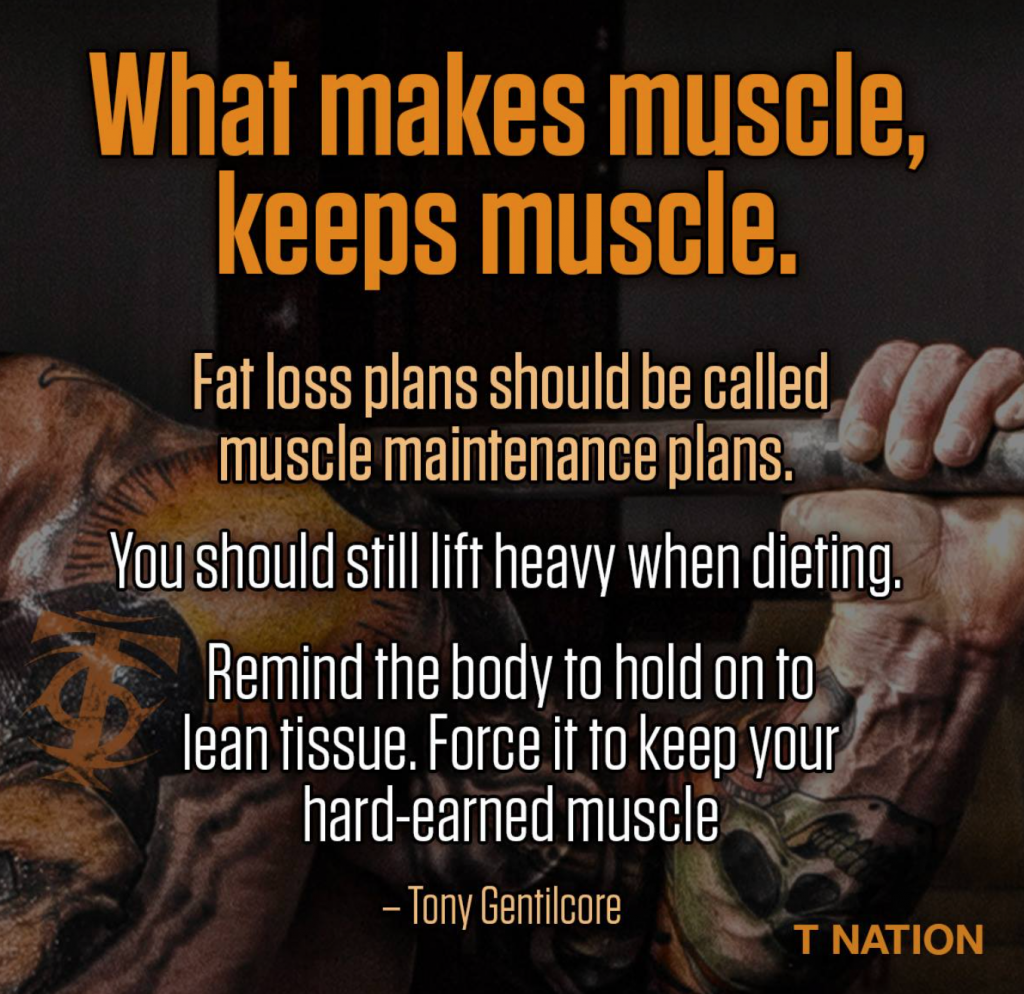
Sure, we can have a discussion on the efficacy of utilizing approaches such as supersets, compound sets, intervals, finishers, circuits, AMRAP sets, and so on and so forth to help promote more metabolic type training.
However, for me, I’m still going to have my client lift appreciable weight to “remind” the body to keep as much muscle as possible during a caloric deficit, which means I’ll still emphasize compound movements such as deadlifts, squats, rows, and various presses in order to hit as many muscle groups as possible in a minimal amount of time.
Seems pretty logical, right?
Again, if I only have a limited number of hours per week with a client, I’m going to use that time as efficiently as possible.
Why, then, would having your client perform 15 lb. standing tricep extensions followed by 1-legged lateral raises while standing on a wobble board even enter the equation?
Sadly, I see this type of programming a lot.
Going back to the dinner party analogy, that’s akin to me vacuuming the insides of my shoes in the in the bedroom closet. It makes absolutely no sense!
Stop Majoring in the Minors
Far too often I see trainers focus on the minor, sweating the details to the detriment of actually giving their clients lasting results.
When you think about it, it’s the Pareto Principle to a T.
“80% of your results are going to come from 20% of the work.”
My good friend, Bryan Krahn, said it about as succinctly as possible not long ago:
90% of the population needs to walk every day, lift weights, drink more water, prepare their own food, and get good quality sleep.
They don’t need massage guns, keto diets, hormone hacks, pre-workouts, or poisonous debates about “shit exercises” or all the coaches you hate.
— Bryan Krahn
I am by no means suggesting I know the best way to train every client – particularly yours.
All I’m saying is that when it comes to program design – and by default, exercise selection – trainers need to take it upon themselves to think critically and ask: “is this really going to get my client the best results in the quickest, most time efficient way possible?”
If not, then start over.
Now, excuse me while I go wipe down my Blu-ray collection.
