I wish I had someone sit me down when I first started in this industry to better explain programming. On one hand I guess it ended up working out, because I wrote a gazillion million kajillion programs over the course of my career and there’s really no better way to gain expertise on a topic than to actually do it.
There’s no other option but to get good at it.
(I’ll save the obvious self-deprecating jab at myself here about not having any girlfriends in high school here)
That said, it really would have saved me a lot of time and second guessing myself if I had a little “cheat sheet of programming wizardry” to help guide me and make my clients into invincible Terminators. Well kiddos…
…today is my gift to you.
What follows is by no means all encompassing nor the panacea of programming. But I think it’s a pretty good starting point for most new trainers and coaches in the industry and I hope it will serve as the bedrock for the bulk of their bulk of programming needs moving forward.
And before I go on, full-credit to Tasha Wolf Whelan who’s talent, expertise, and general badassery served as the inspiration for this compilation. The charts below have been adapted from her.
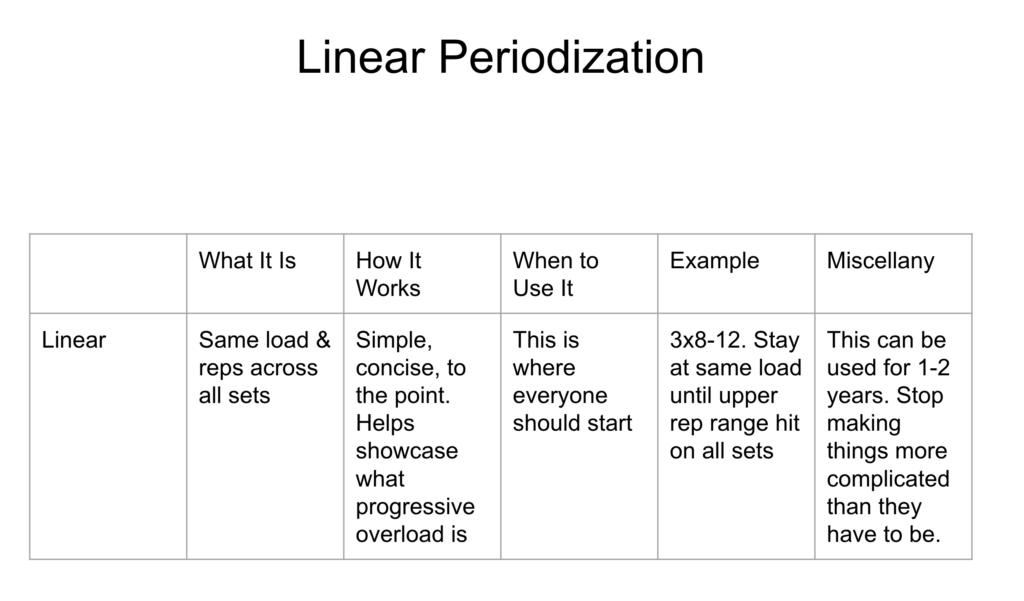
Linear Periodization
Pretty much ALL beginners will (and should) start with a Linear Periodization scheme. This not only introduces the concept of progressive overload to them, but does so in a fashion that’s not overwhelming or complicated. And, in all honesty: most general population clients will LIVE here for the duration of their training career.
3×8-12 will take someone a very long way in their training. Trust me: Phil from accounting doesn’t need contrast sets or Eastern Bloc periodization schemes to peak for his family trip to Toledo this summer.
Obviously the goal is not to keep someone at 3×8-12 the entire time. However, you’d be surprised as to just how long this can go on for. The idea is to start with a load and stay there until 3×12 is achieved on ALL sets.
Week 1: 100 x 10, 9, 8

via GIPHY
Week 2: 100×12,10,10

via GIPHY
Week 3: 100×12,12,11

via GIPHY
Week 4: 100×12,12,12
Boom shaka-laka. Increase load and get to work.
Rinse, wash, repeat.
The bigger picture of Linear Periodization is that you’ll typically begin with a low(er) set/high(er) rep scheme using light to moderate loads and progress to high(er) set/low(er) rep schemes using moderate to heavy loads.
For the visual learners it may look something like this:
Weeks 1-4: 3×8-12
Weeks 5-8: 4×6-8
Weeks 9-12: 5×4-6
As the weeks progress the volume (total number of sets being done) is staying relatively the same, but the intensity (loads being lifted) is increasing.
Fixed Loading
A logical progression from Linear Periodization is something called Fixed Loading. Once a trainee begins to understand how to load his or her’s body and knows what their upper limits are, Fixed Loading is a great option to help push the envelope into more aggressive training.
The idea is to set a fixed load and to then hit a goal number of reps within a training session.
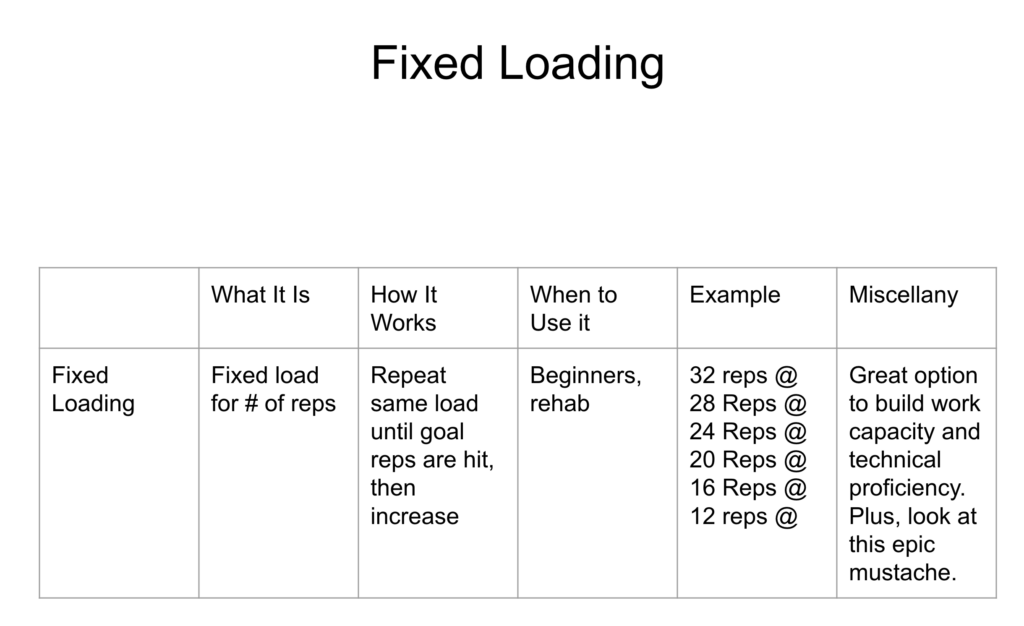
Something to consider here is that the load being used should “match” the rep scheme. Meaning, a higher total rep count would insinuate someone would be using a lighter load and vice versa. A good example would look like this:
Trap Bar Deadlift
32 reps @ 225 (6-8 reps per set)
.
.
.
12 reps @ 300 (2-3 reps per set)
Undulated Periodization
From there, one option that’s massively popular is UNDULATED PERIODIZATION. In short, the concept behind this method is to focus on a specific rep scheme/agenda per workout (or given microcycle; think week to week), or in other words…easy days, medium days, and hard days (from an intensity standpoint).
This is a popular scheme used by many strength & conditioning coaches working with athletes given athletes will typically have “competing” demands (practice, game days, travel, weight-room, etc) depending on the time of year (in-season vs. off-season). However, this is also a very doable approach for many gen pop clients (intermediate to advanced) as it allows for a bit more training variety and provides a different or unique stimulus per training session.
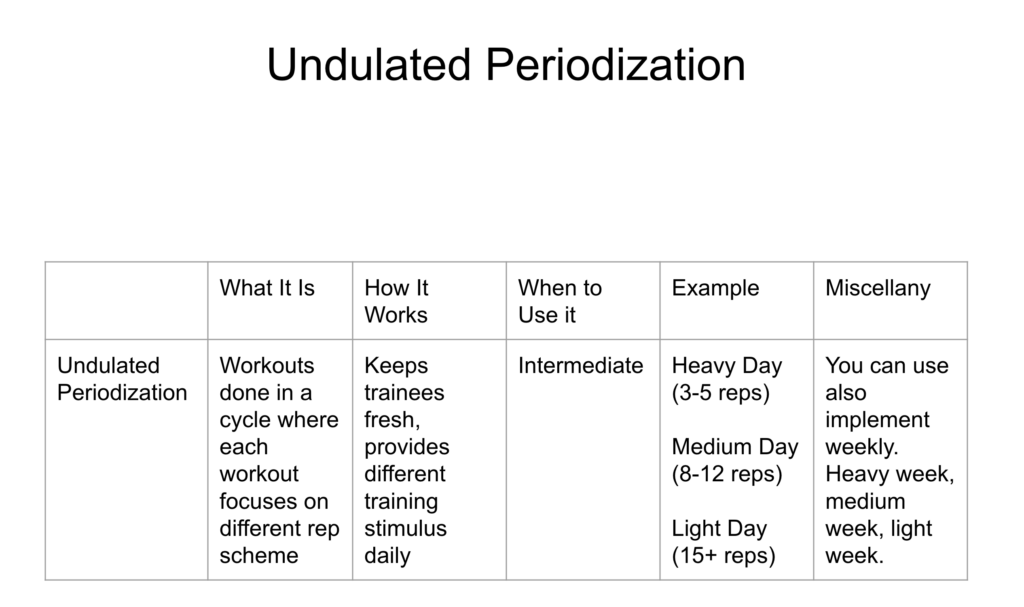
The two most common ways to implement undulated periodization is via a weekly emphasis or a session to session emphasis. Meaning, if you take the weekly approach each session within a week will mirror one another in terms of the end goal.
Week 1: Heavy (all exercises – or at least the main exercises – are completed in the 3-5 rep range)
Week 2: Medium (all exercises completed in the 8-12 rep range)
Week 3: Light (all exercises completed in the 15+ rep range)
The second option is where each session hits every stimulus. The easiest example would be to take the “big 3” (squat, bench press, deadlift) and break if down that way:
Day 1: Squat variation (heavy), bench press accessory (medium), deadlift accessory (light)
Day 2: Bench Press variation (heavy), deadlift accessory (medium), squat accessory (light)
Day 3: Deadlift variation (heavy), squat accessory (medium), bench press accessory (light)
Stage Loading
Next up Stage Loading. This is a unique way of training I adopted during my days coaching at Cressey Sports Performance. In a nutshell your client or athlete will ramp up to a challenging (heavy) few sets of 3-6 reps and then perform a few back off sets at a lighter load within a high(er) rep scheme. When you think about it: It’s PAP (post activation potentiation) training 101. Lift heavy shit to “potentiate” more motor unit firing and recruitment, then when you back off, those subsequent loads will end up feeling lighter and less like you’re going to shit a spleen…
…comparatively speaking.
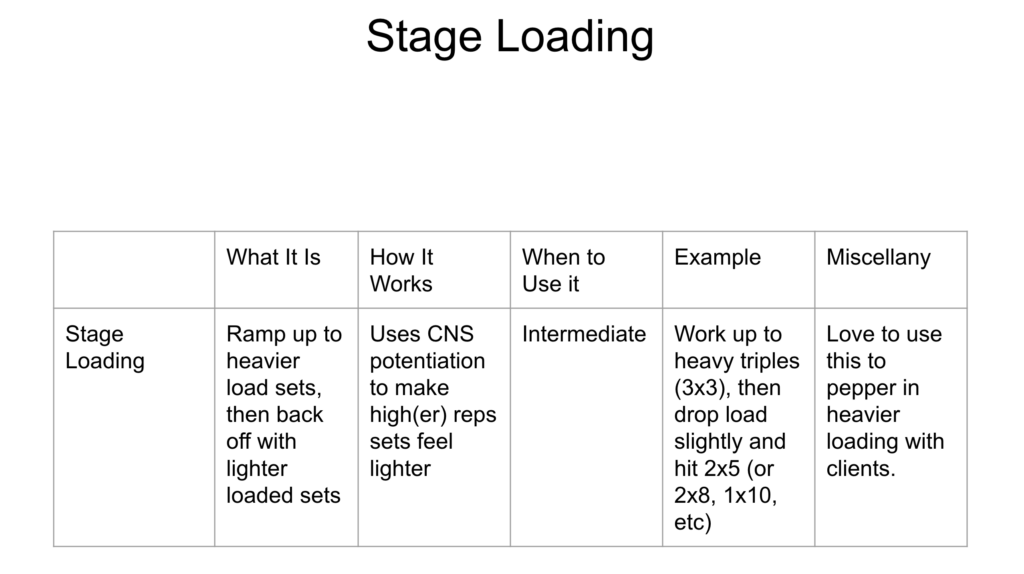
Here’s a quick example of what this would look like:
Front Squats
- Ramp up to a challenging “stage” of 3×3 (these sets should be close to an RPE 9/10)
- Don’t die.
- Back off with another “stage” of 1-2 sets of 10 (added volume)
From there you can periodize things to look like this:
Week 1: 3×3, 1×10
Week 2: 3×3, 1×8 (<— a little heavier)
Week 3: 3×3, 1×5 (<— heavier)
Week 4: 3×3, 2×5
You can also invert the back off sets to begin with 2×5 and end with high(er) rep sets as the week progresses. There are endless permutations here and no ONE right way.
Rest/Pause and Cluster Sets
Speaking candidly, I don’t use any of the following modalities until someone has had a consistent 1-2 years of training under their belt. But I have to say…these are all really fun and I have used both these modalities with beginners in the past to help with work capacity and introduce them to heavier loads in a safe manner.
Important Caveat: Rest/Pause and Cluster Training are often lumped together and I understand why; they are very similar to one another. Kind of like how people confuse or think that Saruman and Sauron from Lord of the Rings are the same person.
WHY WON’T YOU LISTEN TO ME AND GET IT OUT OF YOUR THICK SKULL THAT THEY’RE NOT THAT SAME??!?! THEY’RE JUST NOT! (slams door)
Rest/Pause = extended sets to (technical) failure.
Clusters = pre-planned load and rest periods.
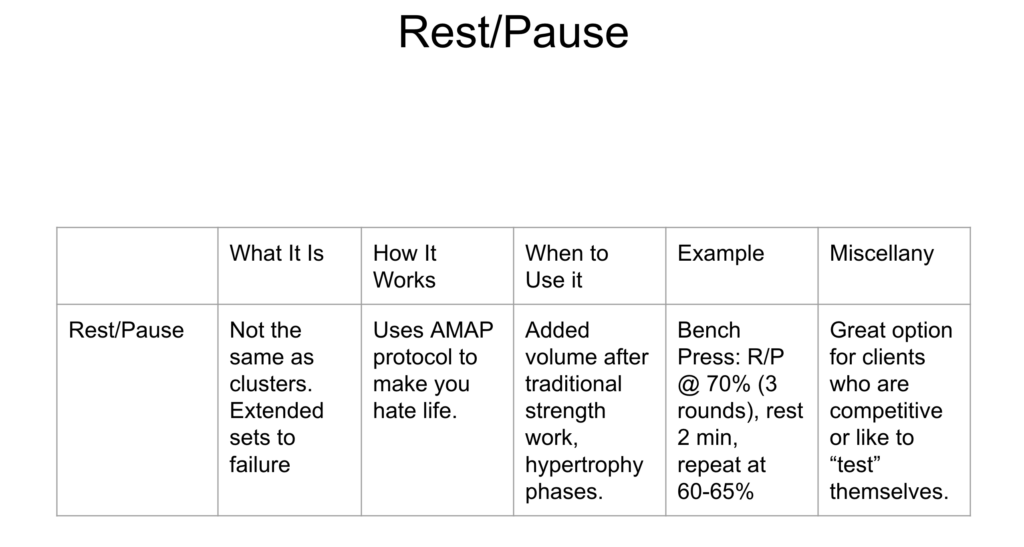
I like to use rest/pause training as an accessory to the main lift of the day as a way to add extra volume in. After the main event (say, bench press) they’ll then do some Rest/Pause training as follows:
- Set 1: 70% of 1RM for AMAP (as many reps as possible), rest 20-30s, AMAP again, rest 20-30s, one more set to AMAP
- Rest 2-5 minutes
- Set 2: 65% of 1RM repeating the same protocol
This is also a great option for clients or athletes who are competitive because the objective then is to try to beat their total # of reps week to week.
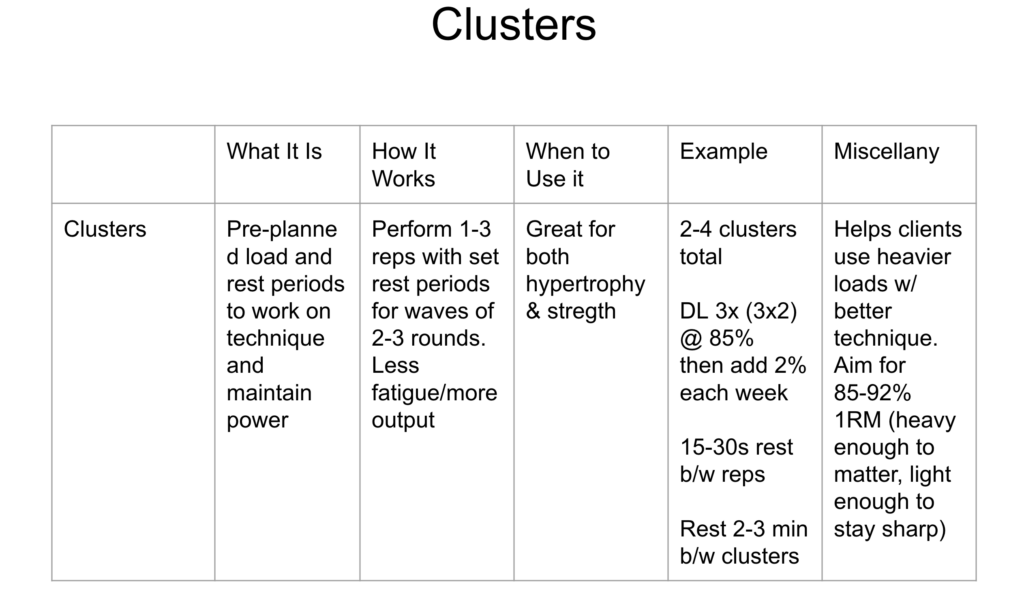
Clusters are best used with the main lift of the day. The main benefit is that it allows trainees to work with heavier loads compared to the same weight being done as straight sets (and with better technique because fatigue is managed).
Using the deadlift as an example: Goal is three cluster sets of 2 reps @ 85% of 1RM
- Cluster #1: 2 reps, rest 15-20s, 2 reps, rest 15-20s, 2 reps
- rest 2-4 minutes
- Cluster #2: 2 reps, rest 15-20s, 2 reps, rest 15-20s, 2 reps
- rest 2-4 minutes
- Cluster #3: 2 reps, rest 15-20s, 2 reps, rest 15-20s, 2 reps
When I am feeling extra spicy, I’ll even have clients do GIANT CLUSTER SETS where I set a fixed time (5-10 minutes) and they perform 1-2 reps at a given percentage (75-85%) every 30s. By minute four this is common…

via GIPHY
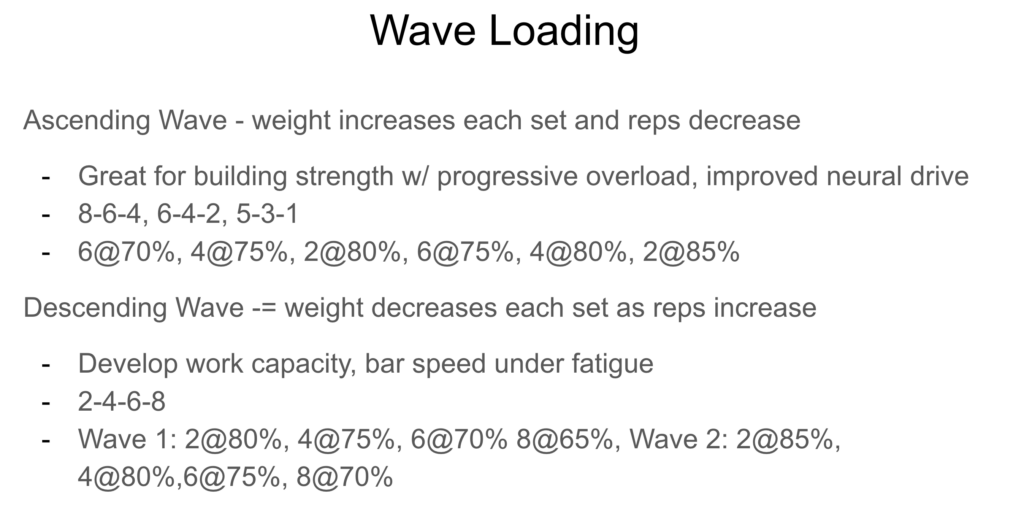
Wave Loading
Last but not least is Wave Loading, which is another example of postactivation potentiation. The 1st wave more or less “potentiates” the nervous system into thinking the load(s) used for subsequent waves is lighter than normal compared to the same load performed as straight sets.