
Quercetin and bromelain are everywhere in the allergy supplement world.
People take them for hay fever, sinus pressure, and other allergy symptoms. But what are the actual benefits, and do they really work, or is this just another supplement trend?
I looked at the research to see what quercetin and bromelain really do, who they might help, and who should avoid them.
🔎 In Summary
- Quercetin with bromelain is mainly used for hay fever and allergy symptoms such as sneezing, itchy eyes, and a runny nose.
- It’s also popular for sinus pressure and congestion, although the evidence there is less clear.
- A few human studies show improvements in allergy symptoms, but it doesn’t work for everyone.
- If you’re on blood thinners, have surgery coming up, or take regular medication, it’s worth checking first.
What Is Quercetin, Exactly?
Quercetin is a natural compound found in foods like apples, red onions, berries and capers. It’s one of the plant nutrients that give fruits and vegetables their colour and protective properties.
You do get small amounts from food, but supplements provide it in much higher doses.
Researchers are interested in quercetin because of its antioxidant and anti-inflammatory effects. In simple terms, that means it may help calm certain processes in the body linked to irritation and inflammation.
There’s also laboratory research showing antiviral activity, but that doesn’t automatically mean it works as an antiviral treatment in real life.
Most of the strongest evidence comes from lab and animal studies. Human research exists, but it’s still limited and developing.
What About Bromelain?
Bromelain is an enzyme that comes from pineapple, mainly from the stem rather than the fruit itself.
It’s often used to help with swelling and sinus discomfort. Some people also take it for joint or muscle pain, including back pain, because of its anti-inflammatory effects.
What makes bromelain interesting is that some of it may survive digestion and enter the bloodstream in an active form. That’s why researchers have looked at it for conditions involving swelling, including sinus pressure.
Like quercetin, it isn’t a miracle cure. But it’s one of the more researched natural enzymes when it comes to inflammation.
Why Are Quercetin and Bromelain Combined?
You’ll often see quercetin and bromelain in the same supplement, and there’s a simple reason for that.
They’re combined because they can support the body in different ways, especially when allergies or sinus issues are involved:
- Quercetin is usually taken to support the body’s response to histamine, which is involved in allergy symptoms.
- Bromelain is taken for swelling and inflammation.
- Quercetin isn’t absorbed particularly well on its own, which is one reason some supplements include bromelain. It’s thought to help improve how quercetin works in the body, although strong human evidence is still limited.
Put simply, one is aimed more at irritation, the other at swelling.
That’s why this pairing shows up so often in supplements aimed at hay fever and sinus pressure.
What Are the Benefits of Taking Quercetin and Bromelain Together?
Most people take quercetin with bromelain for one main reason: allergies.
But there are a few other areas where this pairing is discussed. Here’s what the research actually shows.
✔ Seasonal allergies (strongest evidence)
This is where the best human evidence sits.
In one randomized, double-blind, placebo-controlled study, adults with seasonal allergy symptoms who took 200 mg of quercetin daily for four weeks reported improvements in things like sneezing, itchy eyes and nasal irritation compared with placebo.
There’s also a more recent study in children with seasonal allergies. The kids who took a quercetin-containing supplement alongside their usual antihistamine showed signs of less irritation in the nose compared with the group who only took the antihistamine.
Does that mean it works for everyone? No. The number of big, long-term studies is still quite small, and different products use different formulas.
But overall, there is human evidence suggesting quercetin (and quercetin-containing supplements) may help some people with mild to moderate seasonal allergy symptoms.
It’s not a replacement for prescribed medication, but it may offer extra support for some people.
✔ Sinus congestion
Bromelain is the ingredient most often linked to sinus relief.
It’s been studied for swelling, including in the sinus area. One study found that after people took bromelain by mouth, it could be detected in the blood and even in sinus tissue. That helps explain why it’s researched for sinus pressure and inflammation.
Some reviews suggest bromelain may help reduce sinus swelling, although the evidence isn’t strong enough to call it a guaranteed solution.
Quercetin hasn’t been studied as directly for sinus congestion on its own. But because sinus pressure is often linked to allergies, and quercetin has been studied in allergic rhinitis, it may help indirectly when allergies are the underlying cause.
In other words, bromelain is the main sinus-focused ingredient here, while quercetin plays more of a supporting role.
✔ General inflammation support
You’ll often see quercetin and bromelain described as “anti-inflammatory,” and there’s a reason for that.
A lot of research suggests quercetin can help calm inflammation-related processes in the body, at least in laboratory and animal studies. In simple terms, it appears to reduce some of the signals linked to irritation and inflammation.
Bromelain is also used for similar reasons, mainly around swelling and irritation.
Just keep in mind that when it comes to “general inflammation,” the stronger evidence is still not from big human trials. So this benefit is more of a “promising support” than a guaranteed result.
Side Effects and Who Should Avoid It
Most people tolerate quercetin and bromelain well, especially at moderate doses.
But they’re not suitable for everyone.
Possible side effects
- Mild stomach upset
- Nausea
- Headache (less common)
- Allergic reactions in people sensitive to pineapple (because bromelain comes from pineapple)
Quercetin is generally considered safe in the amounts used in studies (often around 150–200 mg per day), but higher doses can sometimes cause digestive discomfort.
Bromelain can sometimes increase the risk of bleeding because it may have mild blood-thinning effects.
You should be cautious if you:
- Take blood thinners (like warfarin or similar medications)
- Have a bleeding disorder
- Are scheduled for surgery
- Have a known pineapple allergy
- Are pregnant or breastfeeding (limited safety data)
If you’re taking medication for asthma, blood pressure, or immune-related conditions, it’s always best to check with a healthcare professional before starting supplements.
What’s the Usual Dose of Quercetin and Bromelain?
There isn’t one single “correct” dose. It depends on what you’re using it for.
But here’s what research and clinical studies actually show.
Quercetin
In research on seasonal allergies, 200 mg of quercetin per day was used for 4 weeks and showed symptom improvement. So if you’re considering quercetin for allergies, it makes sense to look for at least around 200 mg daily.
Many supplements provide between 150–500 mg per day, which falls within what’s commonly studied.
Bromelain
Bromelain is one of those supplements where the dose really depends on what you’re using it for.
A clinical review found it has been used in a wide range, roughly 200–2000 mg per day, with effects reported even at 160 mg per day.
For sinus issues, one study used 500 mg twice daily for 30 days, and found bromelain reached the sinus tissues.
So what’s a sensible dose to look for?
If you’re taking it mainly for allergies or sinus discomfort, many people start around 200–500 mg per day. Higher doses tend to show up more in joint pain studies.
Quick takeaway
For seasonal allergies, a sensible target is around 200 mg of quercetin daily and 200–500 mg of bromelain a day. For joint pain, studies often use higher bromelain doses, so you’d be looking at around 500 mg a day or more.
If you’re trying it for the first time, start lower and work up. And check first if you take regular medication (especially blood thinners) or you have surgery coming up.
What to Look For in a Good Quercetin + Bromelain Supplement
Shopping for these supplements can get confusing fast, because labels don’t always make it obvious what you’re actually getting. Here’s what I’d check.
Check the quercetin dose
First, look at how much quercetin you’re getting per daily serving (not just per capsule).
If you’re taking it mainly for seasonal allergies, a lot of people aim for around 200 mg of quercetin a day or more, based on what’s been used in studies.
Look at bromelain strength (not just mg)
With bromelain, the number in mg isn’t always enough.
You’ll sometimes see bromelain listed with activity units like GDU or MCU. These are basically “strength” numbers for enzymes. They tell you how active the bromelain is, not just how much powder is in the capsule.
That matters because two supplements can both say “bromelain 200 mg” but one may be much stronger than the other.
If a label only lists “bromelain 100 mg” with no activity units at all, it’s harder to know what you’re getting.
Avoid vague “proprietary blends”
If the label says something like “Allergy Complex 1,200 mg” but doesn’t list exactly how much quercetin and bromelain are inside, I’d skip it.
You want a supplement that clearly shows:
- how much quercetin you’re getting
- how much bromelain you’re getting
- and ideally bromelain activity (GDU/MCU)
Consider more absorbable forms (especially for quercetin)
Quercetin isn’t absorbed very well when taken as a basic powder. That doesn’t mean it won’t work, but absorption can vary.
Because of that, some brands use enhanced forms designed to improve how much actually gets into your bloodstream.
You might see names like:
Quercetin Phytosome® (sometimes called a phospholipid complex). This is quercetin attached to a fat-like molecule, which may improve absorption compared to standard powder forms.
You don’t have to choose an enhanced form. But if you’ve tried regular quercetin before and felt no difference, a phytosome version may be worth considering.
Capsule vs tablet
Most quercetin + bromelain supplements come as capsules.
Capsules are often easier to split into two doses (morning and evening) and can be gentler on the stomach for some people.
Tablets can be fine too, but they sometimes include more binders and coatings. If you have a sensitive stomach, capsules are usually the safer bet.
Best Quercetin and Bromelain Supplements
Below are a few options that meet the criteria we discussed earlier – clear dosing, no vague blends, and sensible amounts of both ingredients.
Disclaimer: Some links in this section are affiliate links. If you buy through them, I may earn a small commission at no extra cost to you. As an Amazon Associate I earn from qualifying purchases.
Nature Provides – Quercetin Phytosome® Complex (1,300 mg) + Bromelain

Available: UK (ships internationally)
Dose (per capsule):
- Quercetin Phytosome (Quercefit®): 300 mg (a more absorbable form of quercetin)
- Quercetin dihydrate: 50 mg (a standard quercetin form)
- Bromelain: 50 mg (120 GDU) (GDU = enzyme activity; this is a modest bromelain dose)
Why it stands out:
This is honestly one of the best quercetin + bromelain supplements I managed to find. It’s very clean (the brand states no fillers, bulking agents, flow agents or preservatives), and the big plus is the phytosome quercetin, which may absorb better than standard powder forms.
Best for: Allergy support + people who want a clean, high-quality quercetin formula
(Probably not the best pick if your main goal is joint pain, because the bromelain dose/activity is on the lower side.)
NOBS Vitamin – Quercetin + Bromelain

Available: Free shipping worldwide (US, UK, Europe, Canada, etc.)
Dose (per capsule):
- Quercetin (dihydrate 95%): 400 mg
- Bromelain: 100 mg (2400 GDU/g) (GDU = enzyme activity; this looks like a stronger enzyme grade)
Why it stands out:
This is a good “simple and solid” option, especially if you want something that ships internationally. The quercetin dose is strong, and it’s helpful that they list bromelain activity (so you can compare strength, not just mg).
Best for: A good all-rounder (allergies + sinus support)
Doctor’s Best – Quercetin Bromelain

Available: Easy to find in both US & UK (Amazon, iHerb, etc.)
Dose (per serving):
- Quercetin (dihydrate): 500 mg
- Bromelain: 250 mg (2400 GDU/g) (GDU = enzyme activity; this is a strong enzyme grade)
Other ingredients: Vegetarian capsule (modified cellulose), rice powder, magnesium stearate (vegetable source), silicon dioxide.
Why it stands out:
This is a strong, well-dosed formula. You’re getting a solid amount of quercetin and a good bromelain strength, which makes it a serious option for allergy, sinus or joint support.
It’s not as “minimalist” as the Nature Provides formula, as it does include standard capsule additives like rice powder and magnesium stearate – but these are common in many supplements.
Best for: Strong dose + good value
EnergyBalance Quercetin + Bromelain

Available: From EnergyBalance (ships across Europe and worldwide) and also via Amazon Germany.
Quercetin: 400 mg per capsule
Bromelain: 82.5 mg (2400 GDU per gram enzyme activity)
Suggested serving: 2 capsules daily
That gives you 800 mg quercetin and 165 mg bromelain per daily serving.
This is one of the cleanest formulas I’ve come across. The label is simple, the doses are solid for allergy support, and the brand focuses heavily on raw material quality.
They use quercetin from plant sources and high-activity bromelain, and the capsules are vegan. The company states they avoid fillers, bulking agents, artificial additives and unnecessary extras.
Looking at their website, I really like what they stand for. They emphasise lab-tested raw materials, no harsh chemical extraction methods, and production in Switzerland under HACCP standards. That kind of transparency is rare.
Best for: Clean, high-quality allergy support from a brand with strong ingredient standards.
Love Life Supplements – Quercetin & Bromelain (LLS)
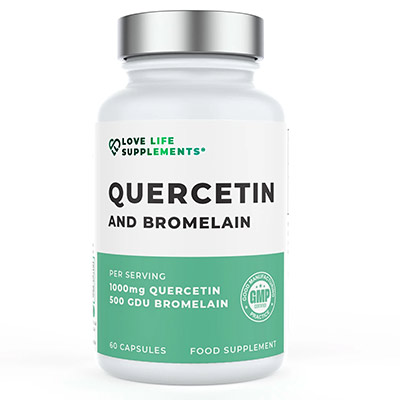
Available: Amazon UK + brand website
Quercetin: 1000 mg per daily serving (2 capsules)
Bromelain: 500 mg (500 GDU activity)
Vegan capsules
This is a strong, straightforward formula with no unnecessary extras. The doses are solid for allergy, sinus and general inflammation support, and the brand clearly states “No Bulking Agents Ever”, which I genuinely appreciate.
It’s surprisingly hard to find supplements that don’t add fillers just to bulk up capsules, so this one stands out for its simplicity and transparency.
Best for: A higher-strength, clean formula with no fillers.
FAQs
Can quercetin with bromelain help with weight loss?
You’ll definitely see this claim online, but the evidence isn’t strong in humans.
Most of the “weight loss” research on quercetin comes from lab and animal studies, where it seems to affect things like fat storage and inflammation.
In real life, we don’t have good human trials showing that quercetin (with or without bromelain) leads to meaningful weight loss.
So it’s not something to take for weight loss, even if the early research looks interesting.
Can they help with asthma?
This is mainly about quercetin, not bromelain.
In animal and lab studies, quercetin seems to calm some of the inflammation linked to allergic asthma.
But we don’t have strong human trials yet, so it’s not a proven asthma supplement. If you have asthma, treat it as “maybe supportive” at most – not a replacement for inhalers or prescribed meds.
Does quercetin with bromelain help eczema?
You’ll see quercetin mentioned for eczema because it may help calm inflammation in the body.
The problem is that most of the evidence so far is from lab/animal research, not good-quality supplement trials in people. So it’s “promising,” but not proven.
Can it lower uric acid or help gout?
This one is interesting. In one human study, 500 mg of quercetin daily reduced uric acid levels in people with high uric acid.
That doesn’t mean it treats gout attacks, though. Gout pain flares are a different thing, and there’s no strong evidence that quercetin replaces gout medication.
So: it may help support uric acid levels, but it’s not a proven gout treatment.
Is quercetin antiviral?
You’ll often see quercetin described as “antiviral,” and technically, that’s not wrong.
In laboratory studies (meaning studies done in cells, not people), quercetin has shown activity against several viruses. It appears to interfere with how some viruses enter cells or replicate.
However, most of this evidence comes from lab research, not large, high-quality clinical trials in humans.
That’s an important difference.
Just because something slows down a virus in a petri dish doesn’t automatically mean it works the same way in the human body.
There have been some small studies looking at quercetin as part of multi-ingredient combinations (for example alongside vitamin C or zinc), but that makes it hard to say what quercetin alone is responsible for.
So the honest answer is this:
Quercetin has antiviral potential based on lab research, but it’s not a proven antiviral treatment in humans. It shouldn’t replace medical care, especially for serious viral infections.
So… Are Quercetin and Bromelain Worth Trying?
If you’re looking for a natural option for seasonal allergies, quercetin with bromelain is one of the more interesting combinations out there.
The strongest case for it is mild-to-moderate allergy support. The evidence isn’t huge, but it’s reasonable – especially for quercetin.
For things like weight loss, asthma, eczema or antiviral effects, the research is either early, limited, or mostly from lab studies. That doesn’t mean it’s useless. It just means expectations should be realistic.
If you decide to try it:
- Choose a formula with clear doses.
- Don’t chase the highest number on the label.
- Give it a few weeks, not a few days.
- And always check first if you’re on medication.
It’s not a miracle supplement. But for the right person, and with the right expectations, it may offer steady support rather than dramatic results.
And honestly, that’s usually how the best supplements work.

