Fetal development: The 3rd trimester
Fetal development continues during the third trimester. Your baby will open his or her eyes, gain more weight, and prepare for delivery.
The end of your pregnancy is near! By now, you’re likely eager to meet your baby face to face. But there’s still a lot happening to the baby, called a fetus, during the last weeks of pregnancy. Use this information to follow along with what’s going on during the third trimester week by week.
As you track your pregnancy, remember that to find your estimated due date, your healthcare professional counts ahead 40 weeks from the start of your last period. That means you’re actually not pregnant the first week or two of what’s counted as your pregnancy’s 40-week timeline.
Week 28: Baby’s eyes partially open
Twenty-eight weeks into your pregnancy, or 26 weeks after conception, your baby’s eyelids can partially open and eyelashes have formed. The central nervous system can direct rhythmic breathing movements and control body temperature.
By now your baby might be nearly 10 inches (250 millimeters) long from crown to rump and weigh nearly 2 1/4 pounds (1,000 grams).
Week 29: Baby kicks and stretches
Fetal development 27 weeks after conception
Fetal development 27 weeks after conception
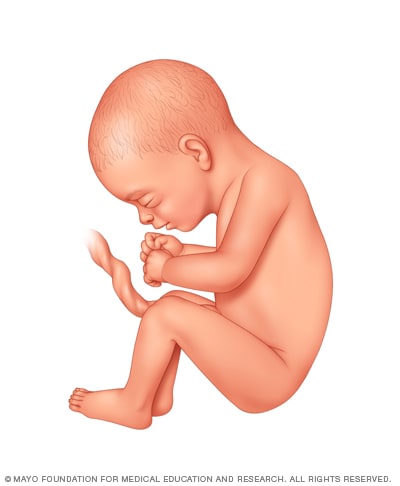
Fetal development 27 weeks after conception
By the end of the 29th week of pregnancy — 27 weeks after conception — your baby can kick and stretch.
Twenty-nine weeks into your pregnancy, or 27 weeks after conception, your baby can kick, stretch and make grasping movements.
Week 30: Baby’s hair grows
Thirty weeks into your pregnancy, or 28 weeks after conception, your baby’s eyes can open wide. Your baby might have a good head of hair by this week. Red blood cells are forming in your baby’s bone marrow.
By now your baby might be more than 10 1/2 inches (270 millimeters) long from crown to rump and weigh nearly 3 pounds (1,300 grams).
Week 31: Baby’s rapid weight gain begins
Thirty-one weeks into your pregnancy, or 29 weeks after conception, your baby has finished most of his or her major development. Now it’s time to gain weight — quickly.
Week 32: Baby practices breathing
Thirty-two weeks into your pregnancy, or 30 weeks after conception, your baby’s toenails are visible.
The layer of soft, downy hair that has covered your baby’s skin for the past few months (lanugo) starts to fall off this week.
By now your baby might be 11 inches (280 millimeters) long from crown to rump and weigh 3 3/4 pounds (1,700 grams).
Week 33: Baby detects light
Fetal development 31 weeks after conception
Fetal development 31 weeks after conception
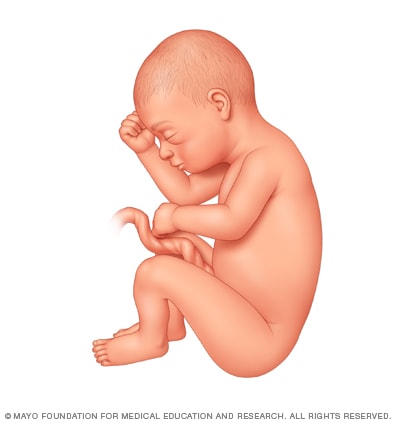
Fetal development 31 weeks after conception
By the end of the 33rd week of pregnancy — 31 weeks after conception — your baby’s eyes can detect light.
Thirty-three weeks into your pregnancy, or 31 weeks after conception, your baby’s pupils can change size in response to a stimulus caused by light. His or her bones are hardening. However, the skull remains soft and flexible.
Week 34: Baby’s fingernails grow
Thirty-four weeks into your pregnancy, or 32 weeks after conception, your baby’s fingernails have reached his or her fingertips.
By now your baby might be nearly 12 inches (300 millimeters) long from crown to rump and weigh more than 4 1/2 pounds (2,100 grams).
Week 35: Baby’s skin is smooth
Thirty-five weeks into your pregnancy, or 33 weeks after conception, your baby’s skin is becoming smooth. His or her limbs have a chubby appearance.
Week 36: Baby has turned head down
Thirty-six weeks into pregnancy, or 34 weeks after conception, your baby’s skin is becoming smooth as more fat is added under the skin. The limbs start to look chubby.
Most babies have turned head down by this point. If your baby isn’t head down, your healthcare professional may talk with you about ways to move the baby in that direction. That’s usually done around week 37.
Week 37: Baby might turn head down
Thirty-seven weeks into your pregnancy, or 35 weeks after conception, your baby has a firm grasp.
To prepare for birth, your baby’s head might start descending into your pelvis. If your baby isn’t head down, your health care provider will talk to you about ways to deal with this issue.
Week 38: Toenails grow
Thirty-eight weeks into pregnancy, or 36 weeks after conception, the measurement around your baby’s head and around the belly are about the same.
Your baby’s toenails have reached the tips of the toes. At this point, most of the lanugo is gone.
By now, your baby might weigh about 6 1/2 pounds (2,900 grams). But size varies quite a bit. Some babies may weigh nearly 9 pounds (4,000 grams) or more by this point in pregnancy.
Week 39: More body fat forms
Thirty-nine weeks into your pregnancy, or 37 weeks after conception, your baby is considered full term.
The chest is getting larger. Fat is being added all over the body to keep your baby warm after birth.
Week 40: Your due date arrives
Fetal development 38 weeks after conception
Fetal development 38 weeks after conception

Fetal development 38 weeks after conception
By the end of the 40th week of pregnancy — 38 weeks after conception — your baby is considered full term.
Forty weeks into your pregnancy, or 38 weeks after conception, your baby might have a crown-to-rump length of around 14 inches (360 millimeters) and weigh 7 1/2 pounds (3,400 grams). Remember, however, that healthy babies come in different sizes.
Don’t be alarmed if your due date comes and goes with no signs of labor starting. Your due date is simply a calculated estimate of when your pregnancy will be 40 weeks. It does not estimate when your baby will arrive. It’s normal to give birth before or after your due date.
From Mayo Clinic to your inbox
Sign up for free and stay up to date on research advancements, health tips, current health topics, and expertise on managing health. Click here for an email preview.
We use the data you provide to deliver you the content you requested. To provide you with the most relevant and helpful information, we may combine your email and website data with other information we have about you. If you are a Mayo Clinic patient, we will only use your protected health information as outlined in our Notice of Privacy Practices. You may opt out of email communications at any time by clicking on the unsubscribe link in the email.
Thank you for subscribing!
You’ll soon start receiving the latest Mayo Clinic health information you requested in your inbox.
Sorry something went wrong with your subscription
Please, try again in a couple of minutes
June 03, 2022
Products and Services
.